



Amway FTC Case: 7 Lessons India’s Direct Selling Industry Can Learn
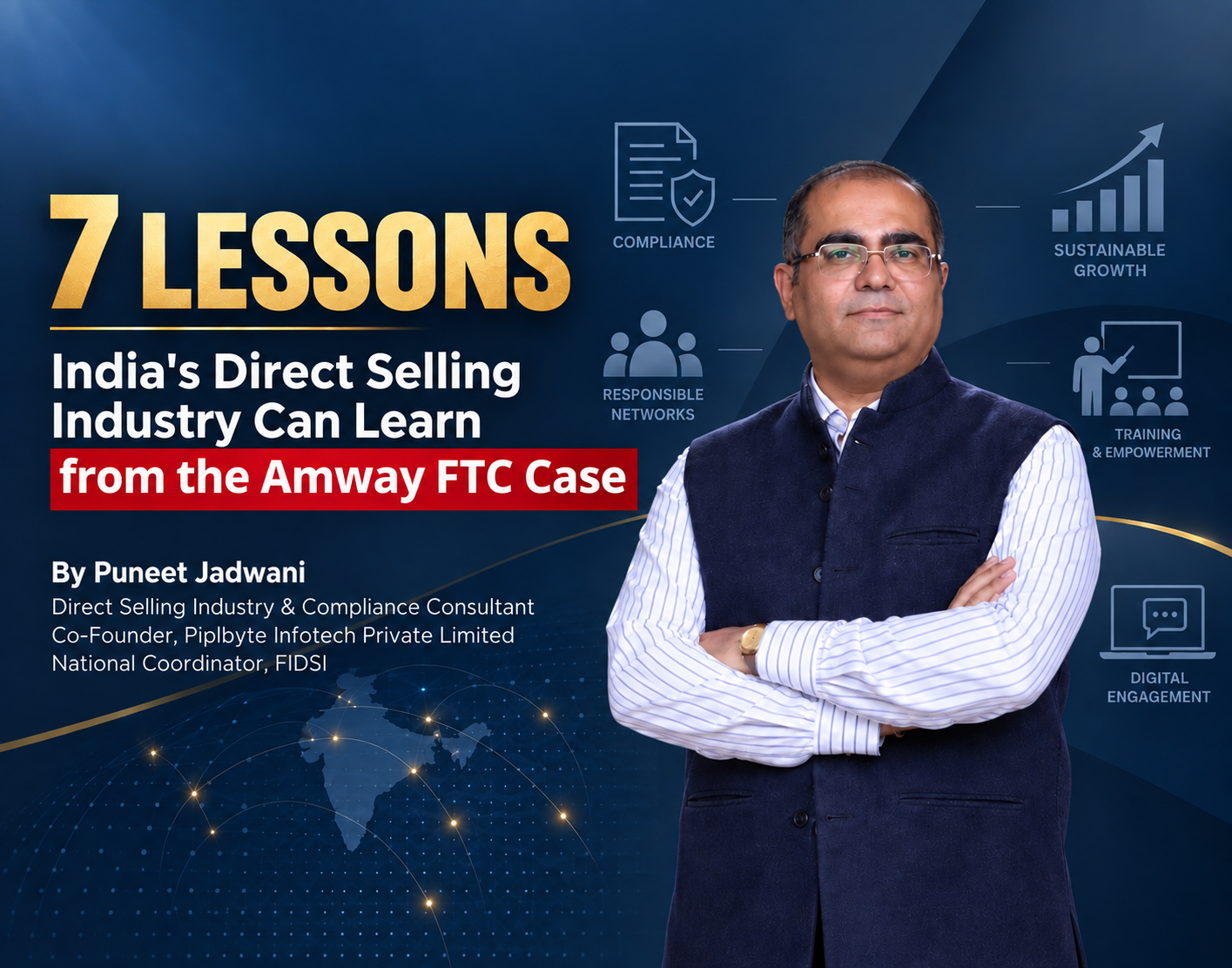
A compliance consultant’s perspective on genuine product demand income claims field practices and responsible growth
By Puneet Jadwani
Direct Selling Industry and Compliance Consultant | Co-Founder, Piplbyte Infotech Private Limited | National Coordinator, FIDSI
The most useful response to a major regulatory development is not to judge another company. It is to examine what the issues can teach us about our own business practices.
The recent Amway FTC case and proposed $225 million settlement have attracted significant attention across the global direct-selling industry. The matter concerns regulatory allegations relating to earnings representations, recruitment practices, product purchasing, retail sales and affiliated training organisations. Amway has disputed the regulators’ characterization of its business.
Rather than passing judgment on the proceedings, this article examines seven practical lessons that India’s direct-selling companies can take from the issues raised.
For India, the more useful question is simple: what can our direct selling industry learn from the issues highlighted by this development?
India already has a specific framework under the Consumer Protection (Direct Selling) Rules, 2021, as amended in 2023. The next stage is to ensure that compliance is reflected not only in agreements and policies, but also in the behaviour a business creates in the field.
1 Genuine Product Demand Must Remain at the Centre
Whenever I review a direct selling business model, I do not look only at how much the company is selling. I first try to understand why people are buying.
Consider two direct sellers who each purchase products worth ₹10,000 in a month. One purchases because the products are genuinely used or sold to customers. The other purchases because the person believes the volume is necessary to remain active, protect a rank or qualify for an incentive.
Both transactions may look identical in the sales report, but they tell very different stories. A sustainable direct selling business should be supported by genuine personal consumption and customer demand, not merely by the requirements of the opportunity.
If there were no income opportunity attached to the products, would people still want to buy them?
That is one of the most useful questions management can ask. If the answer is uncertain, the business needs to understand what is actually driving its turnover.
2 Compensation Should Follow Sales and Not Recruitment
Recruitment is not automatically a problem. Every sales organisation needs people, and direct selling naturally involves building a network of sellers. The important question is what generates the economic activity.
India’s 2023 amendment defines a “network of sellers” around the sale of goods or services for receiving consideration solely from such sale. In practical terms, compensation must remain connected with the sale of goods or services rather than the act of enrolling people.
A simple internal test is to ask: if recruitment stopped for six months, would existing consumer demand continue to generate meaningful product sales? If the business would slow dramatically because new participants were no longer entering and purchasing, management should examine that dependence carefully.
The network should support product sales. Product purchases should not merely support the expansion of the network.
3 Qualification Should Not Create Purchase Pressure
A direct seller may legitimately purchase products for personal use or resale. The concern begins when the person feels compelled to purchase a predetermined quantity regardless of actual need or customer demand.
Qualification rules can sometimes create unintended behaviour. A monthly target may look reasonable on paper but, in practice, may cause people to buy stock only to remain active, preserve a rank or unlock an incentive.
Companies should therefore ask what would happen if a monthly qualification were removed. Would direct sellers still purchase approximately the same quantity? Are unusual volumes concentrated near qualification deadlines? Are products being returned frequently or held as excessive inventory?
A sale recorded in the system does not always explain the commercial reason behind the purchase. That reason matters.
4 Motivation Must Not Become an Income Promise
Direct selling is built around confidence, ambition and personal success stories. There is nothing wrong with celebrating achievement or motivating the field. The line is crossed when motivation creates an unrealistic expectation of income.
There is a difference between explaining that a particular leader built a business over several years and telling a newcomer, “You can also earn ₹5 lakh every month if you follow this system.” Statements such as “You can leave your job,” “Financial freedom is guaranteed,” or “You will recover your money within three months” can materially influence a person’s decision to join or spend money.
An exceptional result should never be presented as a typical or assured outcome. Companies need to look beyond the disclaimer at the bottom of a presentation and understand the overall impression being created by the words, images and success stories used in the field.
A mathematical illustration also needs care. Showing how four people can each introduce another four may explain a calculation, but human behaviour does not follow a spreadsheet. Not everyone will sell, recruit, remain active or achieve the same result.
5 Retail Sales Must Be Genuine and Verifiable
A company may know how much product has left its warehouse, but that figure does not always show what happened next. If the business is described as product-driven, management should have reasonable information capable of supporting that statement.
How much product reaches genuine customers? How much represents genuine personal consumption? Are customer invoices and repeat purchases visible? Are there unusual buying patterns around rank periods? Are direct sellers holding quantities that appear inconsistent with normal use or resale?
The purpose is not to burden the field with unnecessary paperwork. It is to ensure that reported product movement reflects real demand and that retail records can be reasonably verified when required.
6 Training Leaders and Social Media Are Part of Compliance
Companies often review their website, compensation plan, Direct Seller Agreement, return policy and grievance mechanism. Yet the greatest risk may arise in a training hall, WhatsApp group, Zoom meeting or Instagram reel.
If a trainer tells 500 people that everyone must purchase ₹20,000 that month, or a leader posts an expensive car with the message “Join my team and this lifestyle can be yours,” those communications influence how the opportunity is understood. An approved corporate presentation does not automatically correct a different message being delivered in the field.
Companies need practical communication standards covering income claims, product claims, testimonials, lifestyle representations, recruitment messages and compensation-plan illustrations. Leaders should receive regular compliance orientation, and public training material should be capable of review.
The real test is whether the company will act when a violation is committed by a top performer. A policy enforced against a new direct seller but ignored for a senior leader is not being implemented consistently.
7 Compensation Plans Need a Behavioural Compliance Audit
A compensation-plan review should involve more than checking percentages, formulas and payout limits. It should also ask what behaviour the plan encourages.
Does the structure encourage genuine selling and customer development? Does it unintentionally make self-purchasing or recruitment the easiest way to progress? Are direct sellers buying because there is demand, or because the field treats a certain purchase as the price of remaining qualified?
A plan can appear reasonable in a document and still create a very different practice in the field. That is why companies should periodically conduct both a legal review and a behavioural compliance review.
Do not only ask whether the compensation plan is compliant. Ask what people are likely to do because of it.
A useful behavioural review should examine purchasing patterns, rank qualifications, customer sales, refunds and returns, leader communications, training programmes and the actual reasons direct sellers give for making purchases.
From Paper Compliance to Practical Compliance
For the last few years, India’s direct selling compliance discussion has understandably focused on documents. Companies have worked on agreements, websites, return policies, grievance mechanisms and compensation-plan reviews. All of this remains necessary.
The industry must now go one step further.
We need to look beyond turnover and understand why purchases happen. We need to look beyond calculations and understand the behaviour a plan encourages. We need to look beyond approved presentations and understand what leaders are actually communicating. We also need to look beyond having a compliance policy and ask whether the company is prepared to enforce it when enforcement is commercially uncomfortable.
My Takeaway
My takeaway is not that India’s direct selling industry needs more paperwork. What we need is deeper compliance.
A sustainable business should be comfortable asking difficult questions: Would customers buy our products without an income opportunity? Would meaningful sales remain if recruitment slowed? Why are direct sellers purchasing each month? What are our leaders promising? What behaviour does our compensation plan create?
Direct selling should remain a business of selling products and services through people – not a business of selling an opportunity to people.
For me, that is the most important lesson. Compliance should not be judged only by what is written on paper. It should be visible in the behaviour the business creates in the field.
About the Author
Puneet Jadwani is a direct selling industry and compliance consultant, Co-Founder of Piplbyte Infotech Private Limited and National Coordinator at FIDSI. His work focuses on business-model and compensation-plan reviews, direct selling compliance, consumer protection, legal metrology, policy development and the practical implementation of compliance systems in the field.
References
U.S. Federal Trade Commission. Amway FTC v. Case page and official documents. Accessed September 2026.
Department of Consumer Affairs, Government of India. Consumer Protection (Direct Selling) Rules, 2021 and Consumer Protection (Direct Selling) (Amendment) Rules, 2023.