



Direct Selling Compliance Goes Beyond Central Rules
Mizoram’s Registration Requirement Puts State-Level Obligations in Focus
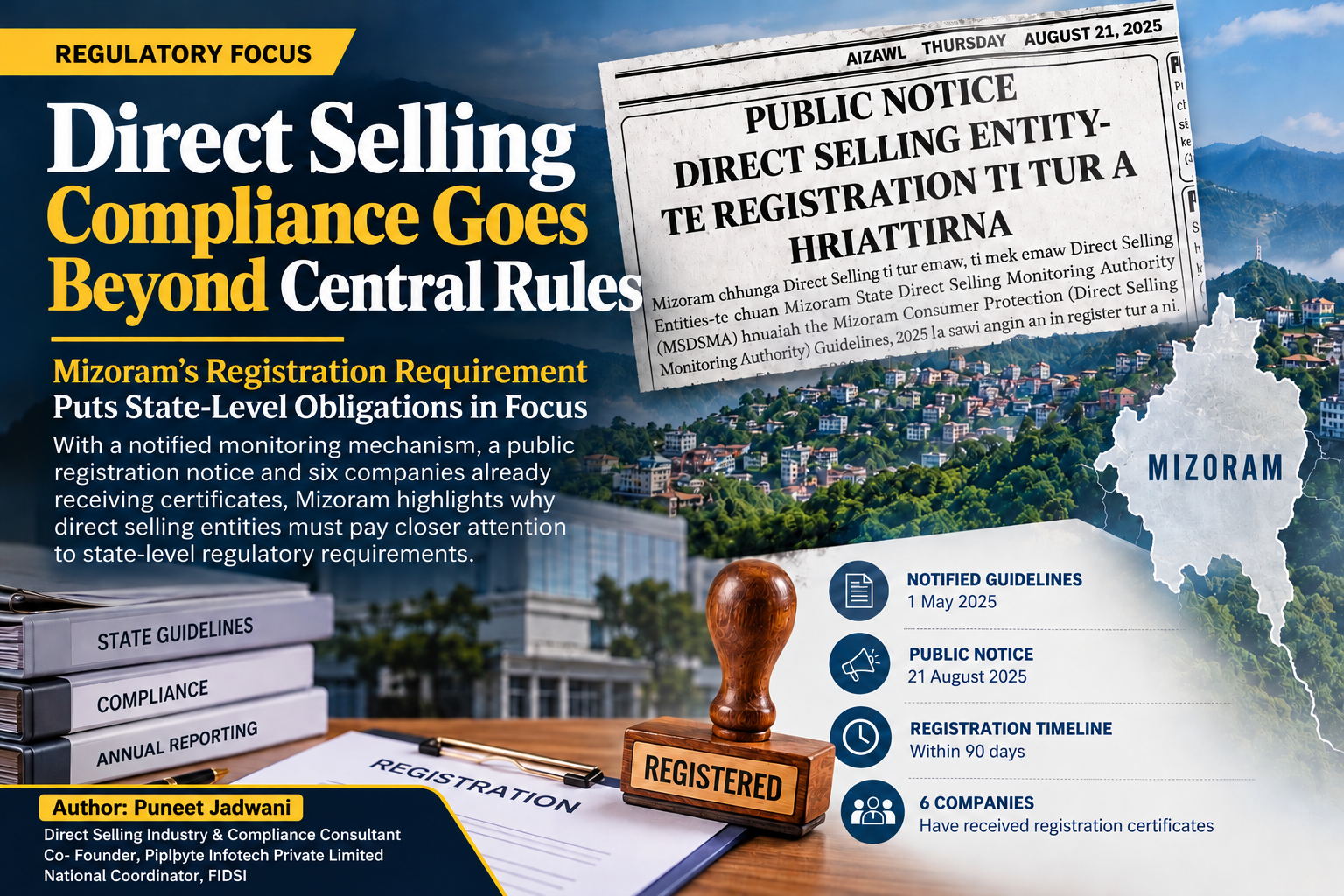
With a notified monitoring mechanism, a public registration notice and six companies already receiving certificates, Mizoram highlights why direct selling entities must pay closer attention to state-level regulatory requirements.
For many direct selling companies in India, regulatory compliance largely begins with the Consumer Protection (Direct Selling) Rules, 2021. Companies focus on their incorporation documents, direct seller agreements, compensation plans, product-related licences and consumer grievance redressal systems. However, an equally important aspect of compliance is understanding the requirements introduced by individual state governments.
Mizoram offers a relevant example.
On 21 August 2025, the Department of Food, Civil Supplies & Consumer Affairs, Government of Mizoram, published a public notice in a local newspaper directing direct selling entities operating or intending to operate in the state to register with the Mizoram State Direct Selling Monitoring Authority (MSDSMA).
The notice followed the notification of the Mizoram Consumer Protection (Direct Selling Monitoring Authority) Guidelines, 2025, published in the Extraordinary Mizoram Gazette on 1 May 2025.
Under Clause 4(1) of these Guidelines, direct selling entities were required to comply with the prescribed requirements and register with the concerned authority within 90 days of the Gazette publication.
The message is significant for companies operating in Mizoram: compliance with the central Direct Selling Rules alone does not address every requirement prescribed under the state’s notified monitoring framework.
The registration process is also no longer limited to a government announcement. Six direct selling companies have already received registration certificates from the Mizoram Government, indicating that the mechanism has entered the implementation stage.
What Is Mizoram’s Direct Selling Monitoring Mechanism?
The Mizoram Consumer Protection (Direct Selling Monitoring Authority) Guidelines, 2025, were notified under Rule 11 of the Consumer Protection (Direct Selling) Rules, 2021.
Rule 11 provides for monitoring of direct selling activities by state governments to ensure compliance with the central Rules.
Through its Guidelines, Mizoram has provided for a State Direct Selling Monitoring Authority responsible for overseeing direct selling activities, examining compliance and addressing matters relating to consumer protection.
The Authority comprises officials from the Department of Food, Civil Supplies & Consumer Affairs, Commerce & Industries Department, Legal Metrology and Police Department, along with a nominated subject matter expert.
Its responsibilities include monitoring direct selling entities, examining complaints, preventing unfair trade practices, addressing misleading advertisements and taking action against violations in accordance with the applicable legal framework.
The objective is not merely to maintain a list of companies operating in the state, but to establish a mechanism through which direct selling activities can be monitored and regulatory compliance assessed.
Registration Is a Mandatory Requirement Under the Guidelines
One of the most important provisions of the Mizoram Guidelines is the registration requirement.
Clause 4(1) requires direct selling entities carrying out or intending to carry out direct selling business to comply with the prescribed requirements and register with the concerned Monitoring Authority or Competent Authority.
The Guidelines provided a 90-day period from their publication for initial compliance.
Companies seeking registration are required to submit a self-declaration under Schedule I and detailed organisational and business information under Schedule II.
The prescribed documents include:
- Certificate of Incorporation and constitutional documents.
- Details of directors and key management personnel.
- Direct selling business model and compensation plan.
- Agreements executed with direct sellers.
- Applicable product licences and trademark documents.
- Tax registrations, returns and financial information.
- Details of consumer grievance redressal arrangements.
The annual registration fee prescribed under the Guidelines is ₹10,000 or 5% of the annual turnover in Mizoram, whichever is lower.
The Guidelines also prescribe timelines for processing applications. Applications are to be acknowledged within seven working days, while scrutiny is to be completed within the specified period. Applicants must be informed of deficiencies and given an opportunity to rectify them.
Where the authority does not decide an application within the prescribed period and no additional information has been sought, the Guidelines also provide for deemed acceptance.
The subsequent newspaper notice reinforces the state’s intention to implement these requirements and bring companies operating within its jurisdiction under the monitoring framework.
What Happens After Registration?
An important aspect of the Mizoram Guidelines is that regulatory compliance does not end with obtaining a registration certificate.
The framework also prescribes continuing responsibilities for direct selling entities.
Clause 4 contains conditions relating to compensation calculations, trademark rights and disclosure of changes affecting compliance.
Clause 5 introduces additional requirements concerning business practices, including restrictions relating to multiple direct seller registrations, ownership transfers of distributorship positions, investment-return commitments and compensation arrangements.
The Guidelines also require companies to ensure that commissions and bonuses are linked to actual sales rather than prohibited recruitment-based activities.
These provisions make it necessary for companies to examine their business practices and compensation structures against the requirements prescribed by the state.
Registration should therefore be understood as part of a wider compliance process rather than a one-time administrative formality.
Annual Reporting Is Also Required
Another important provision is Clause 8, which requires direct selling entities to submit periodic reports to the Monitoring Authority within 90 days of the end of each financial year.
The reports must contain information relating to direct selling activities, including the number of active direct sellers in Mizoram, net sales reported in GST returns, commissions paid and consumer complaints received and resolved.
Companies must also disclose changes in their organisational structure, key officers, grievance redressal arrangements and business plans.
For companies operating across several states, these requirements highlight the importance of maintaining accurate state-wise business information.
A company may have its registered office in one state while conducting business through direct sellers in several others. Such companies need to assess the compliance requirements applicable in each jurisdiction where they operate.
Monitoring, Scrutiny and Consumer Protection
The Mizoram Guidelines provide the Monitoring Authority with powers to seek information, examine relevant documents, issue show-cause notices and initiate inquiries into suspected violations.
The Authority may also require corrective measures and refer matters to the appropriate regulatory bodies where necessary.
The Guidelines address practices such as pyramid schemes, money circulation schemes, misleading advertisements and unfair trade practices.
They also provide for consumer awareness activities and training programmes to improve understanding of legitimate direct selling practices.
This approach recognises that effective regulation involves more than collecting documents. It requires continuing supervision, appropriate scrutiny and awareness among companies, direct sellers, consumers and enforcement authorities.
FIDSI’s Engagement with the Mizoram Government
The Federation of Indian Direct Selling Industries (FIDSI) has also been engaging with the Government of Mizoram on the implementation of direct selling regulations and the functioning of the state’s monitoring mechanism.
During its interactions with senior officials of the Department of Food, Civil Supplies & Consumer Affairs, FIDSI discussed regulatory compliance, scrutiny of documents submitted by direct selling companies and the need for greater awareness of the applicable rules.
The discussions also covered opportunities for training and capacity-building initiatives for government officials and direct sellers.
Such interactions are relevant because the effectiveness of a monitoring mechanism depends not only on the regulations themselves but also on how well companies, enforcement officials and other stakeholders understand their respective responsibilities.
Why State-Level Compliance Deserves Greater Attention
The Mizoram example raises an important question for direct selling companies operating across India: are they giving state-level regulatory requirements the same attention as central compliance?
The Consumer Protection (Direct Selling) Rules, 2021 provide the national framework, but companies must also remain informed about applicable state-level notifications, monitoring procedures and reporting obligations.
A company operating in multiple states cannot assume that maintaining central compliance documentation automatically fulfils every state-specific procedural requirement.
Mizoram’s decision to notify its Guidelines, publish a registration notice and begin issuing registration certificates demonstrates that state-level monitoring is not merely a policy discussion. It is being put into practice.
At the same time, clarity in implementation remains essential. Companies need accessible procedures, transparent scrutiny and clear guidance on their continuing obligations.
The Road Ahead
With six direct selling companies having received registration certificates, Mizoram has taken concrete steps towards implementing its Direct Selling Monitoring Mechanism.
For companies already operating in the state, the immediate priority is to assess their compliance with the notified Guidelines and complete any applicable registration and reporting requirements.
For the wider direct selling industry, the development offers a broader lesson.
Compliance cannot be viewed only through the lens of central regulations. Companies must also pay attention to the regulatory requirements of the states in which they conduct business. As more states examine or strengthen their monitoring arrangements, awareness of state-level compliance will become increasingly important for responsible and sustainable direct selling operations in India.
Author
Puneet Jadwani
Direct Selling Industry & Compliance Consultant
Co- Founder, Piplbyte Infotect Private Limited
National Coordinatior , FIDSI